

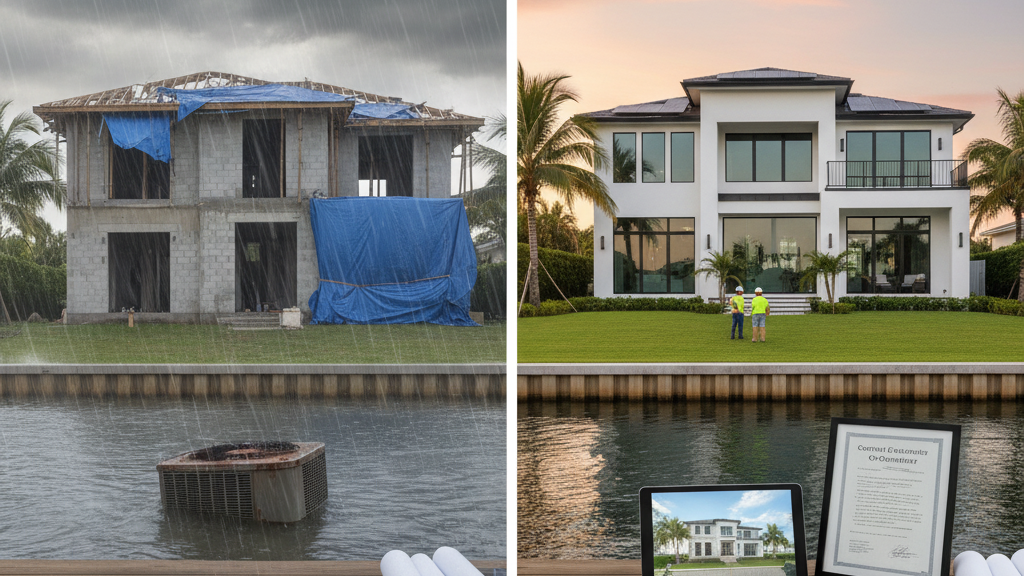
Building or remodeling a luxury coastal home here isn’t just about beautiful design—it’s about getting approvals right the first time. After 10+ years guiding clients through HOA committees and coastal permitting, I’ve learned that success often comes down to preparation, documentation, and steady communication. In this guide, we’ll walk step-by-step through Navigating HOA Rules and Coastal Building Codes in Palm Beach so you can protect your schedule, control costs, and achieve the design you want with fewer surprises.
Understanding the Regulatory Landscape
Homeowners Association (HOA) Rules & Florida Statutes
Overview of Florida Statute Chapter 720 — rights of homeowners, responsibilities of associations.
Chapter 720 of the Florida Statutes governs most HOAs, outlining how associations operate, what notice they must provide, and how owners can access records or dispute decisions. In practical terms, this framework protects both parties: HOAs must follow due process, and owners have defined rights to reasonable review, appeal, and transparency. Knowing the basics helps you identify when to push, when to revise, and when to escalate formally.
What HOAs can and cannot enforce — limitations and common pitfalls (unenforceable rules).
HOAs can regulate aesthetics (colors, roofing, visible equipment), maintenance, and use of common elements. However, rules that conflict with law or building code are not enforceable. A common pitfall is treating “guidelines” like rigid law; many guidelines are standards the board applies case-by-case. If a restriction blocks code-required items (e.g., impact protection), the code typically prevails—but you’ll still want to present a compliant, visually integrated solution to keep approvals smooth.
Coastal Building Codes & Local Jurisdictions
Florida Building Code adoption in Palm Beach County — wind loads, flood zones, elevation, material requirements.
The Florida Building Code (FBC) sets stringent rules for wind resistance, debris impact, and flood design, all critical for coastal sites. Expect requirements for impact-rated glazing or shutters, reinforced connections from foundation to roof, and detailed elevation strategies if your lot sits in a flood zone. These are not optional extras—they’re baked into the approval and inspection process.
County/municipal amendments and local land-development code implications (setbacks, coastal fill, drainage).
Beyond FBC, local land-development codes govern setbacks, site grading, fill limits, permeable area ratios, and stormwater systems. On coastal lots, drainage and outfall management can be decisive for approval. The smartest approach is to model stormwater early and design your grading, hardscape, and landscape to meet both hydrology and aesthetic goals.
HOA Rules — Key Issues for Coastal Luxury Homes
Architectural Control & Exterior Modifications
How HOAs control facades, roofs, colours, shutters in luxury-home communities.
Most HOAs maintain architectural review committees (ARCs) that evaluate massing, roof profiles, exterior colors, driveway materials, and visible equipment. In luxury communities, ARCs often have curated palettes and roof profiles (e.g., flat tile, standing seam metal) to protect neighborhood cohesion. Expect submittals with elevations, material boards, and neighbor-facing perspectives.
How coastal conditions (sea-air, salt, wind) may trigger special HOA protections (e.g., shutters, impact windows) — GRS Community Management
Professional managers (like firms in the GRS Community Management space) often encourage standards that limit corrosion-prone finishes near the ocean and require hurricane protection strategies that blend with the façade. Plan to specify marine-grade metals, concealed fasteners, and color-matched frames for impact windows or shutters to keep aesthetics consistent.
Use, Maintenance & Common Areas
Rules around landscaping, seawalls, docks, outdoor structures in waterfront/ coastal properties.
Waterfront HOAs frequently regulate dock dimensions, piling materials, lighting, and even boat lift profiles. Landscape guidelines may restrict invasive plantings and encourage wind-hardy species. Seawall maintenance may be shared or owner-specific—know which applies to your parcel and how reserves are managed for repairs.
HOA obligations and homeowner rights — when rules are unreasonable or unenforceable — FSR
Large management companies (like those in the FSR ecosystem) emphasize that board decisions must be consistent, documented, and within governing documents. If you face an unreasonable denial, request the written rationale, reference your governing documents (CC&Rs, bylaws, architectural guidelines), and propose a compromise that meets both the rule and your design intent.
Insurance, Flood Risk & HOA Financial Health
How HOAs must maintain reserve funds, how coastal risk impacts association insurance, special assessments.
Coastal risk drives premiums. Sound HOAs maintain robust reserves for seawalls, roofs, and common infrastructure. Review budgets, reserve studies, and recent special assessments. An underfunded HOA can shift costs to owners at the worst time—often after storms.
What homeowners should review in HOA documents (CC&Rs, bylaws) for coastal properties.
Read sections on exterior standards, hurricane protection, docks/seawalls, noise/light, and construction hours. Confirm any view corridor protections; they can affect height, tree selection, and the location of rooftop amenities.
Coastal Building Codes — What Builders & Owners Must Know
Site-Specific Code Requirements for the Coast
Flood zone (Base Flood Elevation) elevation mandates, piling/raised foundations.
If your home sits in a Special Flood Hazard Area, you’ll likely need finished-floor elevations above Base Flood Elevation (BFE) and engineered foundations (e.g., pilings or stem walls). Early survey and geotech are critical to avoid late-stage design changes.
Wind-load design standards, hurricane impact windows & materials for salt-air resilience — Wikipedia
Current code requires homes to withstand region-specific wind speeds and debris impacts. Pair impact-rated glazing with corrosion-resistant fasteners, flashing, and balcony rails. Roof-to-wall connections and continuous load paths are non-negotiable along the coast.
Permit Process & Regulatory Review
What building permit reviewers focus on in Palm Beach County: structural, flood, drainage, fill limits — discover.pbcgov.org
Expect reviewers to focus on structural calculations, wind design, flood compliance (including elevation certificates), and stormwater. Overfill or inadequate detention can trigger immediate revisions. A coordinated civil/architectural set smooths the path.
How HOA architectural control may overlap or conflict with building code/permit review.
Remember: county or municipal approval does not guarantee HOA approval, and vice versa. If HOA aesthetics clash with code (e.g., decorative shutters vs. impact-rated solutions), present a code-compliant product that matches the community’s look. Often the solution is in the detailing.
Compliance, Inspections & Documentation
Final inspections, certificates of occupancy, maintenance of compliance over time.
Closing out permits requires passing final inspections and securing a Certificate of Occupancy. Keep all inspection sign-offs, product approvals, and elevation certificates—your insurance company and future buyers will want them.
Role of documentation in resale value and risk management (insurance, liability).
A complete binder—permits, approvals, warranties, product specs—boosts buyer confidence and can streamline claims after storms. Documentation isn’t paperwork; it’s asset protection.
Common Challenges & Conflict Areas Between HOAs & Coastal Codes
Design vs Restriction Conflicts
When a homeowner’s design vision (e.g., large glass walls, rooftop decks) runs into HOA restriction or coastal setback/fill regulations.
Glass-forward designs may conflict with glare controls, privacy guidelines, or view corridor rules. Rooftop amenities might exceed height envelopes. Start with concept reviews: show how your design protects privacy, limits reflective glare, and stays within massing limits while delivering the indoor–outdoor lifestyle Palm Beach buyers expect.
Strategies to negotiate or amend HOA rules to align with coastal build needs.
Provide precedents from the community, mockups, and material samples. Offer conditional approvals (e.g., planting screens, non-reflective coatings). For structural upgrades like impact systems, propose a standard that the HOA can adopt for consistency across the community.
Timing & Approval Delays
Delays from HOA architectural committees + building code review = extended timelines and additional cost risk.
Parallel-track your submittals. While your architect prepares permit drawings, your designer can assemble the HOA package (color elevations, roof samples, landscape plan). Time buffers of 60–90 days for HOA and 60–120+ days for permit review are common on complex coastal projects.
How to plan for both processes in parallel.
Set a joint review calendar: internal design deadlines, HOA meeting dates, and municipal submittal targets. Hold coordination calls so value-engineering decisions flow into both packages at once.
Cost Impacts & Risk Exposure
Higher cost of compliance (e.g., impact windows, elevated foundation) plus HOA dues/special assessments in coastal areas.
Budget for impact glazing, corrosion-resistant metals, enhanced waterproofing, and engineered foundations. Add HOA dues, potential seawall assessments, and stricter maintenance schedules for oceanfront properties.
Insurance risks if code/HOA compliance not adequately handled.
Insurance underwriters scrutinize documentation. Gaps in permits or noncompliant features can increase premiums or limit coverage. Full compliance adds real financial value.
Best Practices for Homeowners & Builders
Pre-Build / Pre-Purchase Checklist
Review HOA governing documents (CC&Rs, architectural guidelines, reserve study).
Spot red flags before you buy: roof restrictions, fence limits, dock rules, and height caps. Confirm reserve strength and any planned special assessments for seawalls or common roofs.
Verify lot’s flood zone, elevation, fill history, drainage.
Order surveys, elevation certificates, and past grading or fill records. Understanding the hydrology of your lot will save weeks later.
Engaging Early with HOA & Building Review
Submit architectural plans early to HOA & consult code requirements concurrently.
Early concept reviews reduce friction. Bring your architect, builder, and landscape architect into HOA conversations from day one so the design aligns with both aesthetics and code.
Seek builder/architect experienced in coastal code + HOA communities.
Experience shortens timelines. Teams familiar with Palm Beach County coastal building compliance for custom homes can anticipate committee concerns and prep robust permit sets.
Communication & Documentation Strategies
Keep records of approvals, meeting minutes, changes, correspondence.
Create a single digital folder for HOA submissions, stamped plans, and emails. When leadership changes, your project history stays clear and defensible.
Allocate budget & timeline buffers for both HOA and regulatory reviews.
Reserve 10–15% contingency for coastal upgrades and review-driven revisions. Schedule buffers prevent small delays from snowballing.
Maintenance & Long-Term Compliance
Staying current with HOA rules (landscape, exterior finish, shutters) and code updates (storm prep, flood mitigation).
HOA standards and codes evolve. Plan periodic exterior maintenance (sealants, coatings, hardware checks) and keep hurricane-readiness features in serviceable condition.
Plan for resale: ensure documentation, warranties, code-compliant upgrades all recorded.
Well-documented homes sell faster and appraise stronger. Keep warranty logs, product approvals, and inspection closeouts readily accessible.
FAQs — HOA Rules & Coastal Building Codes for Palm Beach Homes
Can an HOA stop me from installing hurricane-impact windows if the code allows them?
Generally, no—safety codes prevail. However, the HOA can require specific finishes, frame colors, or styles to maintain community aesthetics. Present samples that meet both goals.
How many feet must I elevate my home in a flood zone in Palm Beach County?
It depends on your Base Flood Elevation and local freeboard requirements. Obtain an elevation certificate early and design your foundation to meet or exceed the mandated height.
What happens if my HOA’s rules conflict with code requirements?
Code typically supersedes, but you still need HOA sign-off. Work with your design team to show compliant options that respect the community’s design language.
Are there special fees or assessments for coastal/seawall homes in luxury communities?
Yes, many waterfront communities maintain reserves for seawalls, docks, and shoreline protection. Review budgets and reserve studies before purchasing.
How often do HOAs update their architectural guidelines, particularly for coastal resilience?
Updates vary by community. Many HOAs revise guidelines every few years or after major storms. Ask for the latest version and confirm if any updates are pending.
Conclusion — Aligning HOA Compliance with Coastal Build Excellence
Why navigating both HOA rules and coastal building codes is essential for luxury homes in Palm Beach.
Thriving on the coast means honoring both design cohesion and structural resilience. Mastering Navigating HOA Rules and Coastal Building Codes in Palm Beach protects your investment and keeps your project moving.
Key takeaways: plan early, align vision with regulation, understand cost & timeline implications.
Engage your HOA early, coordinate with code requirements, and budget for coastal-grade materials and timelines. Clear documentation and proactive communication are your best allies.
Final advice: collaboration between homeowner, builder, architect and HOA yields the best outcome.
Choose a team fluent in navigating HOA rules Palm Beach coastal homes and coastal building codes Palm Beach County FL. For more guidance, explore Our Service Area, read Navigating Coastal Building Codes: Essential Considerations for Luxury Homes in South Florida, and discover community insights in Moving to Palm City, FL. Ready to start? Call 561-962-4567 and let’s align your vision with every rule and code—so your Palm Beach home is stunning, compliant, and built to last.